Lugh Lámhfhada Part II
Welcome back to the Black Dragon Tavern, Lightbearers. Wipe the mud from your boots and grab a heavy pint. The hearth is roaring, and tonight, the ledger runs red with the blood of gods.
In our last session, we left Lugh Lámhfhada, the master of all trades, at the gates of Tara. But a god of war needs an armory. And Lugh built his not through honest forging, but through cold, calculated, and utterly ruthless extortion.
Here is how the Long-Armed God armed himself for the apocalypse.
The Blood-Price: The Murder of Cian
It started with an ambush. While Lugh was gathering forces for the impending war, his father, Cian, was hunted down and brutally murdered by three brothers: the Sons of Tuireann [1]. When Lugh discovered his father's mangled corpse, he didn't fly into a blind, reckless rage. Instead, he sprang a legal trap.
Under ancient tribal laws, Lugh demanded an éraic—a formal blood-price [2]. But the price he set was mathematically impossible. He forced his father's murderers to travel the mythic world and retrieve the deadliest, most heavily guarded artifacts in existence. They were sent on a suicide mission to build the high king's armory.
And the spoils of this vengeance were devastating.
Illustration of Lugh's magical spear by H. R. Millar
The Spear of Assal
First among the extorted treasures was the Spear of Assal [3]. This was not a mere piece of sharpened iron; it was a weapon of absolute, inescapable fatality. When the wielder threw this spear and uttered the activation word "Ibar" (meaning Yew), it would never fail to strike and kill its target [3].
Better yet, a second command, "Athibar" (Re-Yew), would instantly recall the blood-soaked weapon right back into the thrower's hand [3]. It was the ultimate weapon of precision for a god whose very name, Lámhfhada, meant "Long-Arm."
Irish Wolfhound
Failinis: The Invincible Hound
Next came Failinis. A god of Lugh's lineage—a bloodline steeped in canine symbolism and hunting prowess—required a hound to match. The Sons of Tuireann procured an invincible beast, the mythical hound of the smith god [1].
Failinis was invulnerable in combat, a supernatural apex predator that effortlessly tore through the vanguards of any army foolish enough to stand in the King's path. Where Lugh walked, the invincible hound followed, ensuring that no flank was ever left exposed and every routed enemy was run down.
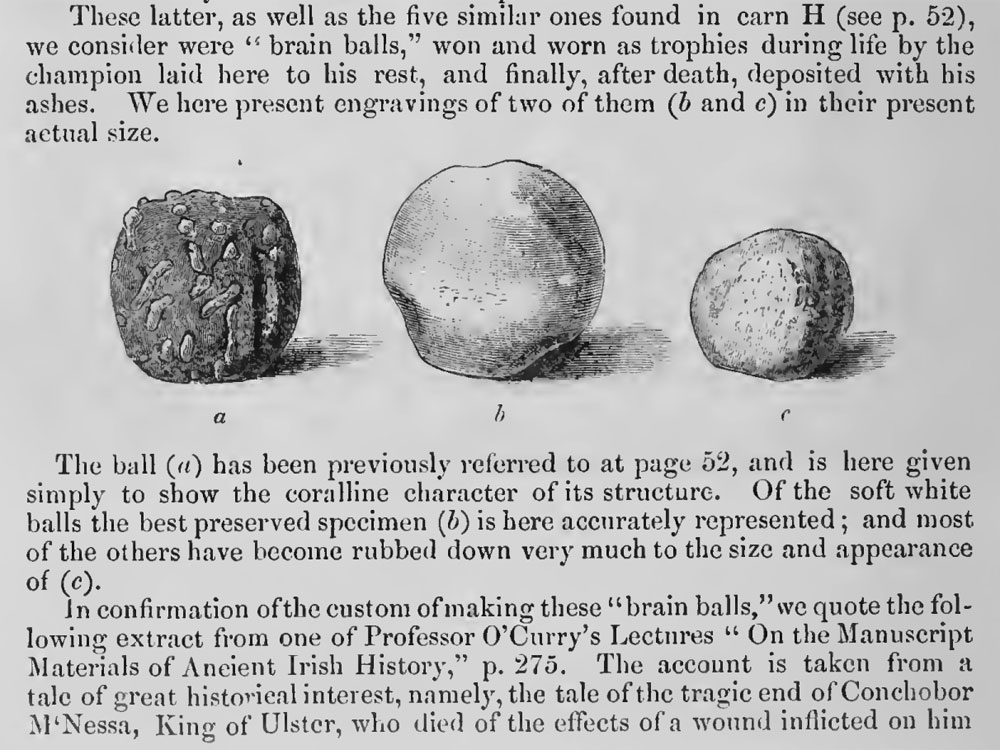
Clay and chalk balls found at Loughcrew
The Tathlum: The Brain Ball
But the most brutal weapon in Lugh's arsenal wasn't forged from steel or bred in a divine kennel. It was crafted from the dead. Time to get gritty, travelers.
In ancient Irish warfare, there existed a terrifying, macabre type of sling-stone known as a liathróidí inchinne—a "brain ball" [4]. When a great champion was killed, the victorious warriors would extract the defeated enemy's brain, mix it heavily with lime, roll it into a dense sphere, and bake it rock-hard in the blazing sun [4]. These calcified projectiles were considered the deadliest of all missiles, carrying the stolen strength of the slain warrior.
The mythological Tathlum utilized by Lugh was the absolute apex of this dark science. At the apocalyptic Second Battle of Mag Tuired, Lugh finally faced his grandfather, Balor of the Evil Eye [5]. Balor's singular gaze was so venomous that his massive eyelid had to be hoisted open with pulleys, incinerating anything it looked upon.
Just as the heavy lid was being raised, Lugh loaded his Tathlum into his sling. With the brutal, flawless aim of the Samildánach, he fired the calcified brain ball directly into the Evil Eye [5]. The impact was so catastrophic that it drove Balor's eye backward through his own skull, turning its lethal gaze upon the Fomorian army massed behind him and slaughtering them instantly [5].
Remember these artifacts, Lightbearers. The Spear that answers to the Yew, the invincible hound, and the deadly sphere forged from lime and the minds of the dead. In the world of the Black Dragon Tavern, the relics of the past have a habit of surfacing when you least expect them.
You never know when you might need to call upon the armory of the Long-Armed God to solve the puzzles that lie ahead. Keep your wits sharp and your tankards full. We'll see you at the threshold.
The Tavern Library
Primary Sources
[1] O'Curry, E. (Trans.). (1863). Oidhe Chloinne Tuireann (The Fate of the Children of Tuireann). The Atlantis. (This translation details the murder of Cian and the impossible blood-fine exacted by Lugh).
[2] Kelly, F. (1988). A Guide to Early Irish Law. Dublin Institute for Advanced Studies. (Provides the historical context for the éraic, or blood-price, in early Irish society).
[3] MacKillop, J. (2004). A Dictionary of Celtic Mythology. Oxford University Press. (Details the mechanics of the Spear of Assal and its magical activation commands Ibar and Athibar).
[4] Keating, G. (17th Century). Foras Feasa ar Éirinn (The History of Ireland). (The foundational historical account describing the macabre ancient practice of creating a liathróidí inchinne or brain ball).
[5] Gray, E. A. (1982). Cath Maige Tuired: The Second Battle of Mag Tuired. Irish Texts Society. (The primary medieval text recording Lugh using the sling-stone to drive the Evil Eye backward through Balor's skull).
Take a Deeper Look
📖 For the Reader:
-
Oidhe Chloinne Tuireann: The Fate of the Children of Tuireann translated by Richard J. O'Duffy: This is the essential text for reading the unabridged tragedy of Cian's murder and the impossible blood-price demanded by Lugh. O'Duffy's translation provides excellent notes and vocabulary for those wanting to dig into the roots of the story.
-
Cath Maige Tuired: The Second Battle of Mag Tuired translated by Elizabeth A. Gray: Published by the Irish Texts Society, this is considered the gold standard scholarly translation of the epic battle where Lugh defeats Balor. It features extensive notes that are invaluable for understanding the cultural and mythological context of Lugh's arrival at Tara.
More posts on Gaelic / Celtic Lore
Who is the goddess Boann from Celtic mythology? The river goddess is a symbol of life, but there are many versions of her tale....
Nechtan the God of Water In a previous post, we talked about the goddess Boann. This time, we’re going to talk about her husband, the Celtic god Nechtan. Nechtan is actually perceived as many different gods in Celtic mythology, but we’re going to refer specifically......
Pagan Spirits of Disney’s Frozen II We’ll start off by pointing out that this animated feature actually didn’t have a villain. Instead, the main characters, Anna and Elsa, had to struggle with their inner demons and focus on their strengths. I thought that was really......
Unearth Odin's quest for ancient runes in Norse mythology, a tale of sacrifice, wisdom, and cosmic knowledge in the world of the Æsir gods....
Learn about the notable dragons of European myths and the legendary stories they appear in....